With a 780% increaseHow Israel’s propaganda machine expanded over three years to 2.2 billion shekels to confront boycott movements
An Arabic Post investigation deconstructs Israel’s multi-front apparatus against the Boycott, Divestment and Sanctions (BDS) movement between 2024 and 2026
This is an interactive story. Browse the charts below, and click the “official documents” buttons to view the source PDF files within the page.
An investigation conducted by the website Arabic Post revealed how Israel’s efforts to counter the Boycott, Divestment, and Sanctions (BDS) movement evolved between 2024 and 2026 from a limited public-relations issue into a multi-front state apparatus combining massive government funding, legal engineering, and cross-border influence networks.
Official budget data and Israeli government documents reviewed by us showed that spending related to the propaganda apparatus and efforts to combat boycott movements surged from tens and hundreds of millions to billions of shekels. Israeli efforts also expanded to include not only traditional media campaigns, but also American universities, state legislatures, and even arenas of international law.
The investigation relied on an analysis of dozens of official Israeli documents, including state budget books (2024–2026), Knesset protocols, documents from the Ministries of Foreign Affairs and Diaspora Affairs and the Prime Minister’s Office, government reports and official funding programs, as well as investigative reports and leaked documents.
Israeli propaganda spending map (2024–2026)
These materials were handled using an audit-based methodology that distinguishes between full institutional budgets and documentable items directly linked to propaganda or countering boycotts, in order to avoid duplication or inflating the figures.
The investigation focused on the period from 2023 to 2026, as the phase that witnessed an unprecedented restructuring of this confrontation, particularly after the Gaza war.
The investigation does not treat Israel’s war against the boycott movement as merely a public-relations campaign or propaganda activity, but rather deconstructs it as an integrated political, financial, and legislative structure.
The investigation mapped Israeli efforts in the battle of international propaganda and the war of narratives across three main tracks: funding, legislation, and hybrid warfare.
Funding: From 250 million to 2.2 billion shekels
A review of official documents and government statements reveals that the period between 2023 and 2026 saw the largest restructuring in years of Israeli spending related to its international image and propaganda, driven by three main factors:
The Gaza war and its media repercussions.
The global rise of boycott (BDS) campaigns.
The decline in popular support for Israel at Western universities and cities.
The result was a surge in funding, an expansion of implementing bodies, and the transformation of propaganda into a central state file.
How did Israel’s war against the boycott swell?
The comprehensive funding map for Israeli propaganda from 2024 to 2026 can be traced as follows:
Comprehensive funding map for Israeli propaganda (2024)
As international criticism escalated during the Gaza war, Israel’s public diplomacy and propaganda efforts, known as “hasbara,” shifted from traditional diplomatic activity into a centralized media mobilization system led directly by the government.
Knesset committee documents show that total spending on propaganda and countering international boycott movements in 2024 amounted to about 251 million shekels (approximately $83 million), in a model closer to a “media war economy” than to ordinary communications policy.
At the level of supporting infrastructure and indirect funding, hundreds of millions—around 220 million shekels—passed through the Government Advertising Bureau to carry out campaigns. However, these funds are not counted in the total because they represent implementation channels for the budgets of various bodies, rather than independent funding.
This figure includes:
Government ad purchases.
Official media campaigns.
Video production.
Digital campaign management.
Marketing services for ministries.
Comprehensive funding map for Israeli propaganda (2024)
Knesset documents and reports by the Ministry of Diaspora Affairs and Combating Antisemitism reveal that in 2024 Israel treated hasbara and countering the boycott movement as two overlapping but functionally and financially distinct tracks.
While hundreds of millions of shekels were allocated to international propaganda campaigns (194 million shekels), tens of millions were allocated separately (57 million shekels) to building networks to counter the boycott movement within Western universities and communities.
While the hasbara apparatus focused on managing the war of narratives before the media and global public opinion during the Gaza war, a parallel track was allocated to countering what Israel describes as “delegitimization” linked to the Boycott, Divestment, and Sanctions (BDS) movement within Western universities and societies.
1- The anti-boycott track (2024)
The Ministry of Diaspora Affairs and Combating Antisemitism emerged as the clearest arm in countering boycotts and the BDS movement.
Budget data reveal that during the war years, the Ministry of Diaspora Affairs transformed from a ministry traditionally concerned with relations with Diaspora Jews into a government funding platform increasingly directed toward supporting networks and organizations working to counter the “delegitimization” of Israel, although budget documents do not always precisely distinguish this role from the ministry’s other institutional functions.
The ministry’s institutional budget in 2024 amounted to 105 million shekels, of which around 57 million shekels were allocated to supporting civil society organizations and networks concerned with countering boycott movements.
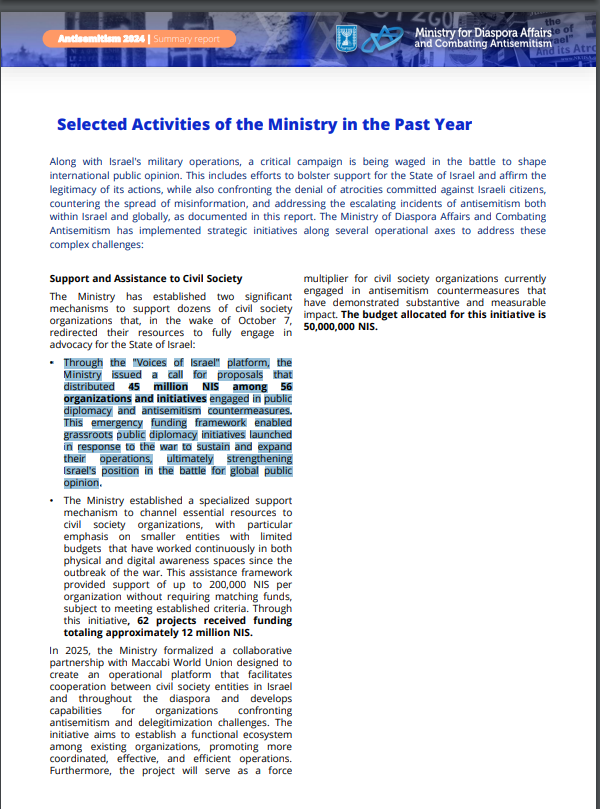
According to the Ministry of Diaspora Affairs’ 2024 report on combating antisemitism, issued in April 2025, Israel’s Ministry of Diaspora Affairs created parallel funding tracks to support civil organizations that decided to redirect their resources and dedicate themselves to working as agents of public diplomacy and advocacy on behalf of Israel, as follows:
1- Large-scale funding (Voices of Israel): Through a “Call for Proposals” mechanism, the ministry, via the “Voices of Israel” platform, injected 45 million shekels. This emergency funding was distributed to 56 civil organizations and initiatives.
This funding formed an “emergency financial framework” that enabled pro-Israel grassroots initiatives to sustain and immediately expand their operations, forming a counter-front in the arena of global public opinion.
Voices of Israel platform funding (2024)
2- Specialized support mechanism for smaller organizations: Recognizing the need to activate low-cost “digital guerrilla warfare” and grassroots diplomacy, the ministry established a specialized funding track for small organizations with limited budgets that had been active since the outbreak of the war.
This mechanism provided support of up to 200,000 Israeli shekels per organization (12 million shekels in total). Most importantly, it exempted these organizations from the requirement to provide “matching funds,” accelerating the flow of money to field and digital operations.
2- The international propaganda track (2024)
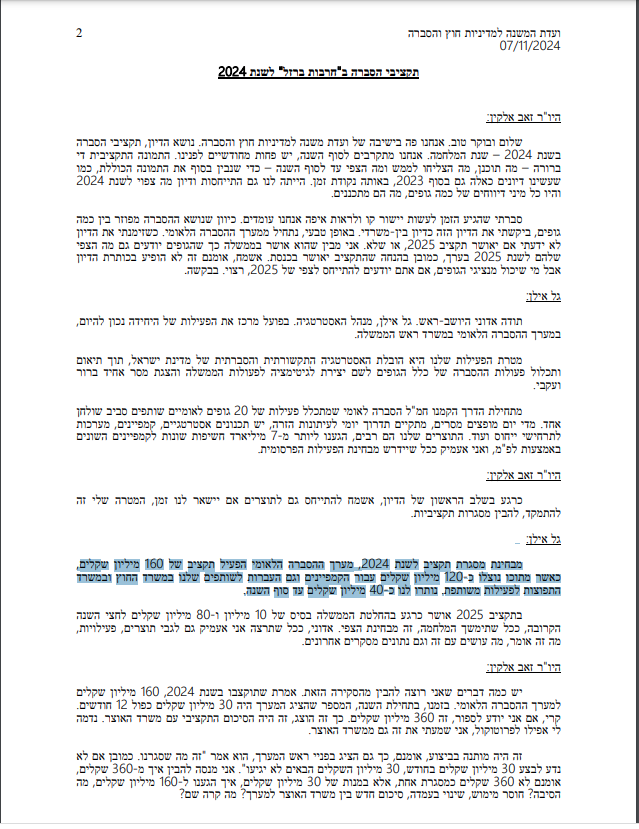
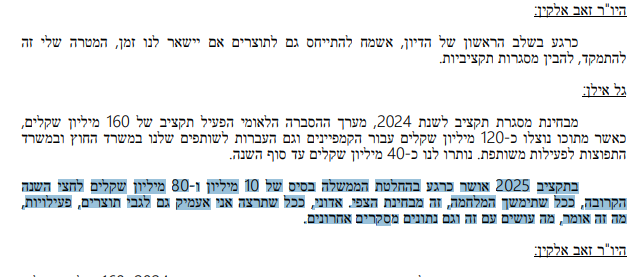
At the heart of this system stood the National Hasbara Unit affiliated with the Prime Minister’s Office, which received the largest share of funding, at 160 million shekels.
This unit was not merely a media body, but an operations room bringing together more than 20 government entities, managing daily messages, coordinating campaigns, and directing international discourse during wartime. It also used part of its budget to fund government partners, transferring around 15 million shekels to the Ministry of Foreign Affairs and nearly 9 million shekels to the Ministry of Diaspora Affairs to carry out joint campaigns.
National Hasbara Unit (Prime Minister’s Office) spending (2024)
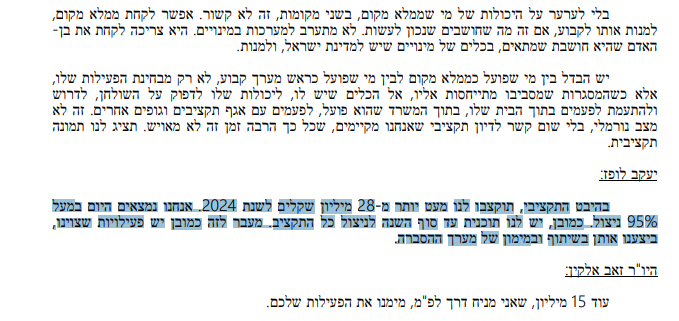
In the field of international propaganda as well, the Ministry of Foreign Affairs maintained its traditional role in managing international discourse, with a direct hasbara budget of around 28 million shekels, equivalent to 1.6% of the ministry’s total budget of 1.7 billion shekels, with a focus on foreign media and embassies.
Ministry of Foreign Affairs hasbara spending (2024)
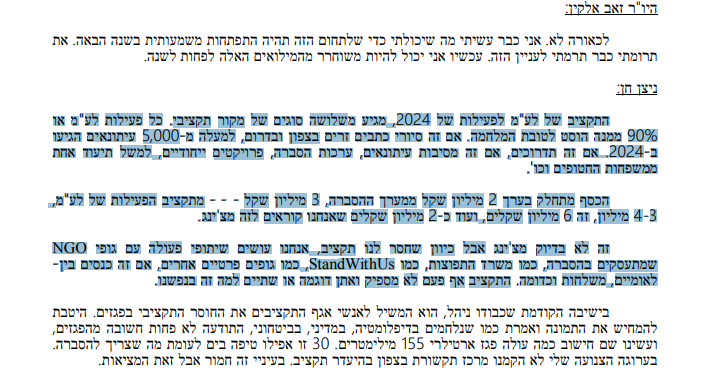
Alongside it, the Government Press Office played a complementary role by managing relations with international journalists, with spending ranging between 3 and 4 million shekels, while around 2 million shekels were allocated to the IDF Spokesperson to strengthen messaging related to military operations.
Government Press Office spending (2024)
The government funding system network and its tracks
Click any node to view its connections and details
Government funding bodies
Implementation arms & platforms
Beneficiary civil networks
Comprehensive funding map for Israeli propaganda (2025)
Israeli budget documents for 2025 show a clear transition from the “emergency response” model of 2024 to a broader, more institutionalized model, with a clearer separation between international propaganda budgets and budgets for countering the boycott movement.
While external hasbara budgets saw a major jump, funding for countering the boycott movement grew at a more restrained pace.
This separation reflects an important strategic shift. In 2025, Israel was no longer relying solely on direct propaganda campaigns, but began building two parallel systems: the first devoted to restoring international legitimacy through media and digital diplomacy, and the second aimed at containing boycotts within Western societies through nongovernmental organizations and networks.
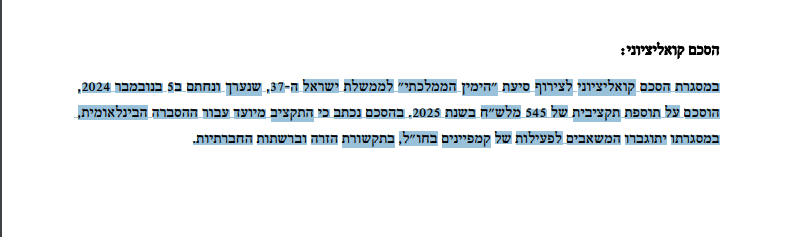
According to the documents, Israel spent around 845 million shekels (approximately $285 million) in 2025, of which about 805 million shekels were allocated to rebuilding the propaganda machine after the Gaza war, and 40 million shekels to countering international boycott movements.
At the level of supporting infrastructure and indirect funding, the 2025 budget allocated 248 million shekels to the National Cyber Directorate and 385 million shekels to the National Digital Agency. These two figures cannot be counted in full as propaganda spending, but they provide the government’s broader technical infrastructure in the fields of monitoring, digital security, services, and platforms—elements that form part of the operating environment for modern campaigns and tracking anti-Israel discourse.
As for the Government Advertising Bureau, its funding in the 2025 budget reached around 603 million shekels. This office does not necessarily represent a full external propaganda item, but it is the executive arm through which government campaigns pass, including hasbara campaigns, videos, and targeted digital activity.
1- The anti-boycott track (2025)
Countering international boycott movements remained concentrated mainly within the Ministry of Diaspora Affairs and Combating Antisemitism.
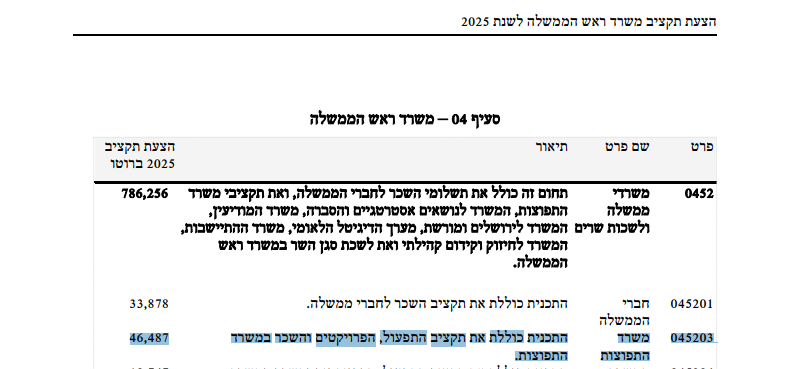
The core budget of the Ministry of Diaspora Affairs and Combating Antisemitism amounted to around 46.5 million shekels in 2025, covering the ministry’s broader tasks, while the more direct funding tools for countering “boycotts” and mechanisms for supporting civil networks were linked to separate additional programs worth around 30 million shekels, according to a Knesset protocol document.
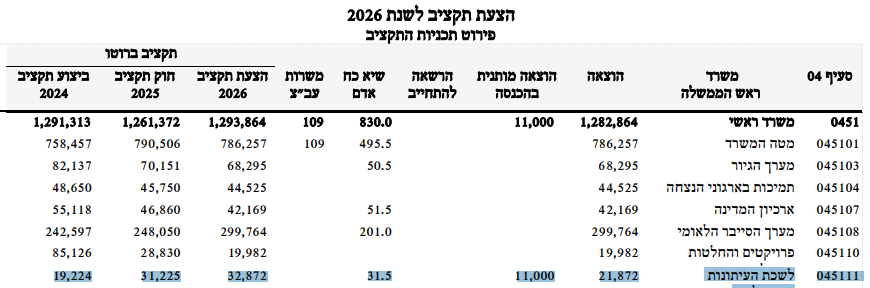
In official Israeli budget documents and other official documents (such as the document attached below), figures in the tables are written in “thousands of shekels” (אלפי שקלים), not in single shekels.
Therefore, the figure written in the tables actually means that number multiplied by 1,000: what appears in thousands is in fact in the millions, and what appears in millions is in fact in the billions of shekels.
Ministry of Diaspora Affairs & Combating Antisemitism spending (2025)
Israeli budget documents do not fully reveal the names of the funded organizations.
A 10 million shekel item was also allocated to the Ministry of Strategic Affairs, linked to influence and boycott-related files. This funding was directed more toward building influence networks within universities, communities, and civil institutions than toward broad mass-media campaigns.
Comprehensive funding map for Israeli propaganda (2025)
2- The international propaganda track (2025)
According to a Knesset protocol document, the National Hasbara Directorate affiliated with the Prime Minister’s Office entered 2025 with an initial framework of 10 million shekels as a fixed base, in addition to 80 million shekels for the following half-year if the war continued.
This means the system’s expected operating figure was 90 million shekels—lower than the actual 2024 figure of 160 million—but it reflects continued funding for the propaganda “command room” that coordinates messages and campaigns among government bodies.
National Hasbara Directorate spending (2025)
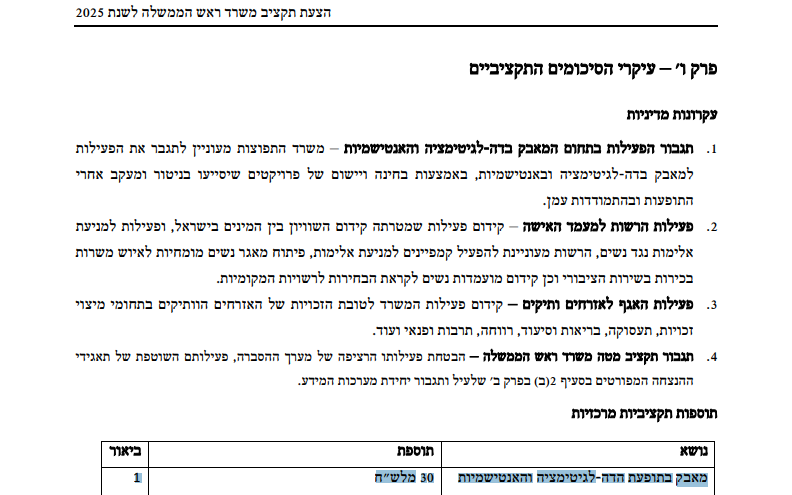
In the Prime Minister’s Office budget document for 2025, an important and direct item related to countering boycotts appears: 30 million shekels under the title “Combating the phenomenon of delegitimization and antisemitism.”
“Combating delegitimization and antisemitism” item (2025)
The document explains that this funding is allocated to establishing projects aimed at building a “knowledge infrastructure for action,” including creating a comprehensive global picture and monitoring and analyzing trends.
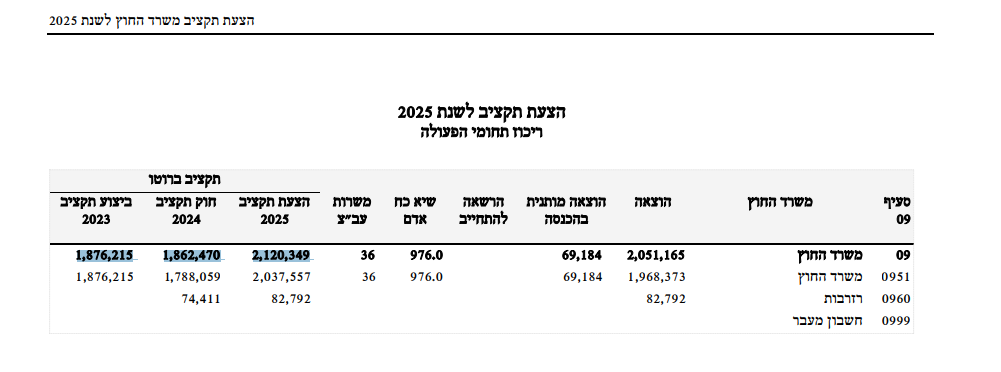
At the Ministry of Foreign Affairs, the ministry’s general budget for 2025 amounted to around 2.120 billion shekels in total, including 2.051 billion shekels in net spending.
Israeli Ministry of Foreign Affairs spending (2025)
According to the Knesset website, 545 million shekels of this budget were allocated to public diplomacy and propaganda.
Public diplomacy and propaganda spending (2025)
The 2025 budget explicitly states that strengthening the ministry’s activity in 2025 includes public diplomacy, hasbara activity, foreign aid, operating missions, and opening a new embassy in Paraguay. Therefore, the Foreign Ministry can be regarded as a central arm of external propaganda.
The Government Press Office appears in the 2025 budget with 20.2 million shekels. It is the body responsible for relations with foreign journalists, tours, coverage, and the media workroom for the international press.
The Prime Minister’s Office document confirms that one of its goals in 2025 is to “advance government policy in Israel and around the world through hasbara tools and information accessibility,” in addition to establishing the Government Press Office as a professional work center for media professionals and spokespeople.
Knesset records for 2025 show that the Israeli government resorted to cutting 150 million shekels from higher education budgets to fund influence campaigns and recruit influencers.
Comprehensive funding map for Israeli propaganda (2026)
Israeli budget documents for 2026 reveal that official propaganda is no longer a limited item within a specific ministry, but has become a broad government funding system distributed among the Ministry of Foreign Affairs, the Prime Minister’s Office, the Ministry of Diaspora Affairs, and advertising and digital media bodies.
The figures show that Israel has treated the battle for global public opinion after 2023 as a front parallel to the military and political fronts.
Government spending on propaganda efforts and countering boycott movements reached around 2.246 billion shekels (approximately $778 million), of which around 189 million shekels were allocated to countering international boycott movements and 2.057 billion shekels to propaganda and hasbara efforts.
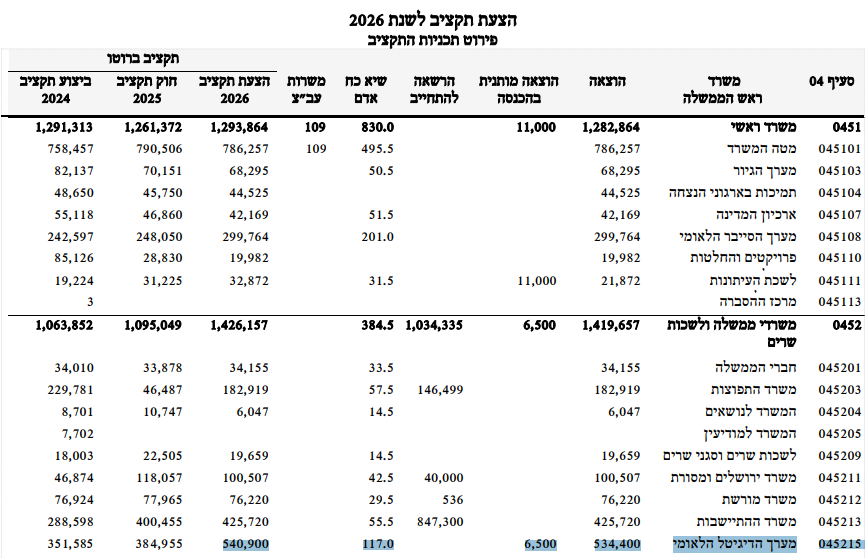
At the level of supporting infrastructure and indirect funding, the 2026 budget allocated 300 million shekels to the National Cyber Directorate and 540 million shekels to the National Digital Agency.
National Digital Agency spending (2026)
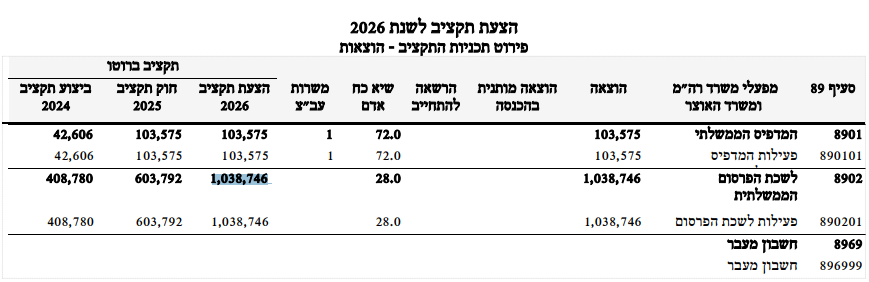
As for the Government Advertising Bureau, its funding in the 2026 budget reached around 1.38 billion shekels. This office does not necessarily represent a full external propaganda item, but it is the executive arm through which government campaigns pass, including hasbara campaigns, videos, and targeted digital activity.
Government Advertising Bureau spending (2026)
1- The anti-boycott track (2026)
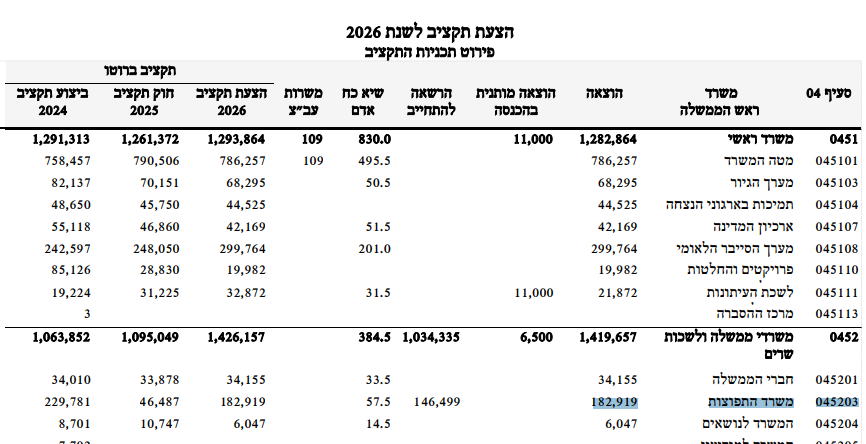
The government allocated 182.9 million shekels to the Ministry of Diaspora Affairs and Combating Antisemitism, the body most politically linked to the file of countering international boycotts.
Ministry of Diaspora Affairs & Combating Antisemitism spending (2026)
The documents explain that its tasks include confronting what Israel describes as its “delegitimization” and strengthening ties with Jewish communities abroad, meaning that an important part of the confrontation is managed through Western societies, universities, and civil influence networks.
Israeli budget documents do not fully reveal the names of the funded organizations.
A 6 million shekel item was also allocated to the Ministry of Strategic Affairs, linked to influence and boycott-related files.
Comprehensive funding map for Israeli propaganda (2026)
The following two maps show the detailed distribution of funding within the Ministries of Foreign Affairs and Diaspora Affairs, the two central arms in the battle of propaganda and countering boycotts:
Israeli Ministry of Foreign Affairs funding map
Israeli Ministry of Diaspora Affairs funding map
2- The international propaganda track (2026)
Israeli budget data reveal a radical shift in the function of the Ministry of Foreign Affairs in just three years. After public diplomacy represented a limited budgetary margin in 2024, by 2026 it had come to account for around seven-tenths of the ministry’s budget, reflecting the transformation of the war over the narrative from a secondary file into a central mission of Israeli diplomacy.
According to Israeli reports, 2.35 billion shekels were allocated to the Ministry of Foreign Affairs’ public diplomacy budget in 2026, a major leap compared with previous years.
As for international media, 21.8 million shekels were allocated to the Government Press Office, the body responsible for managing relations with foreign journalists, organizing field tours, international coverage, and facilitating access to the official narrative.
Government Press Office spending (2026)
Unlike in 2024 and 2025, the available documents for 2026 do not show a large independent budget for the National Hasbara Directorate affiliated with the Prime Minister’s Office, indicating that the center of international propaganda management has shifted to the Ministry of Foreign Affairs.
Legislation: A multi-front legal war against the boycott movement
Israel did not limit itself to confronting the Boycott, Divestment, and Sanctions (BDS) movement through media campaigns and funding influence networks. In parallel, it worked to build a multi-level legal and legislative structure aimed at raising the political and legal cost of engaging in boycotts, both inside and outside Israel.
The map of Israeli legislative efforts to counter boycott movements can be outlined as follows:
The 2011 law: The cornerstone of the legal confrontation
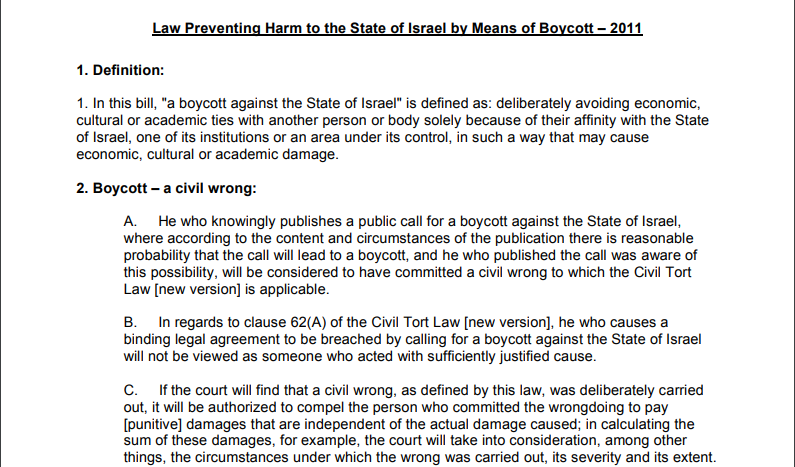
The Law for Prevention of Damage to the State of Israel through Boycott, passed by the Knesset on July 11, 2011, formed the main starting point of this confrontation.
The law was not limited to boycotting Israel within its internationally recognized borders, but expanded the definition to include calls to boycott individuals or institutions because of their connection to Israel or to areas under its control—a definition that effectively includes the settlements.
Most importantly, the law moved the battle from the political sphere into the courts, granting individuals and institutions that claim to have suffered harm because of boycott calls the right to file civil lawsuits seeking compensation. It also allowed the state to impose economic and administrative sanctions on entities supporting boycotts, including denying them public funding and certain government privileges.
Thus, from the perspective of Israeli law, boycotting became not merely a political position, but an act that could carry financial and legal burdens.
Law for Prevention of Damage to the State of Israel through Boycott (2011)
This legal structure did not stop at financial deterrence. In 2017, Israel expanded its tools by passing an amendment to the Entry into Israel Law, granting the authorities the right to deny entry to foreigners who support boycotts of the state.
This amendment marked an important shift from punishing domestic activity to pursuing cross-border political activity.
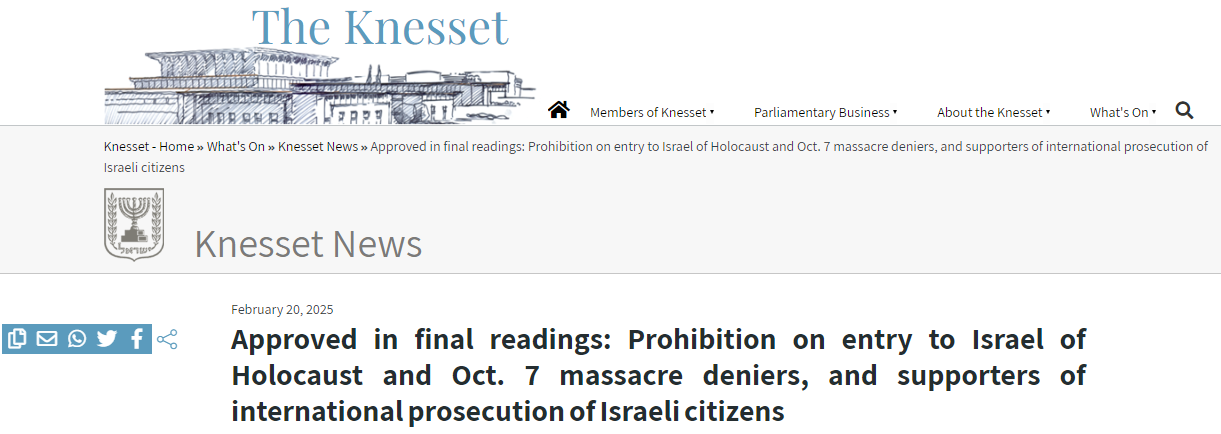
After the Gaza war, this track took on a more hardline dimension with a new amendment in February 2025, which expanded entry-ban powers to include broader categories of Israel’s critics and supporters of international accountability. This reflects an expanded definition of “threat” to include not only traditional boycotts, but also legal and human rights tools used to pressure Israel.
February 2025 amendment to the Entry into Israel Law
The legal battle beyond the borders
The confrontation was not confined to Israel itself. In the United States and Europe, Israel benefited from supportive legal and political environments that provided it with an additional protective network against boycotts.
In the United States, local anti-boycott laws emerged as one of the most important non-Israeli legal lines of defense.
More than 30 U.S. states adopted laws or executive orders that, in some cases, require individuals or companies seeking to contract with government bodies to pledge not to participate in boycotts of Israel. Although many of these laws predated 2023, they gained renewed importance as pro-Palestine protests escalated after the Gaza war.
In February 2023, the U.S. Supreme Court reinforced this trend when it declined to hear a challenge to Arkansas’s anti-boycott law, leaving the law in force and giving political and judicial momentum to similar legislation.
Leaked government documents revealed that the Ministry of Strategic Affairs provided grants to highly influential Christian Zionist organizations, such as Christians United for Israel (CUFI) and the Israel Allies Foundation, to leverage their right-wing influence to pressure state legislatures into passing these laws.
Britain: An attempt to formalize the confrontation
In Britain, a similar track emerged in September 2024 through the Public Bodies (Overseas Matters) Bill, which sought to prevent local councils, universities, and public bodies from adopting boycott policies against foreign states, in a move that observers viewed as effectively targeting campaigns to boycott Israel.
Although the bill did not become law due to political changes, it revealed that the battle over boycotts is now also being waged through legislative efforts in one of the most important Western arenas.
From countering boycotts to legally shielding Israel
As international pressure intensified, this legal confrontation expanded beyond economic boycotts.
In January 2025, the U.S. House of Representatives passed a bill allowing sanctions to be imposed on personnel of the International Criminal Court who pursue American citizens or U.S. allies, foremost among them Israelis.
Although this measure does not directly target BDS, it demonstrates the expansion of the concept of “legal protection” to include shielding Israel from mechanisms of international judicial accountability.
Legal circumvention of transparency requirements
At the heart of this strategy emerged a more sensitive dimension: how to fund foreign influence networks without running afoul of U.S. transparency laws, foremost among them the Foreign Agents Registration Act (FARA).
Leaked documents and correspondence indicate that the design of entities such as “Kela Shlomo,” which later evolved into a project known as “Concert – Together for Israel” and then “Voices of Israel,” was not merely an administrative restructuring, but part of a legal framework designed to channel Israeli government funding to organizations active in the United States and Europe through civil-society fronts rather than direct government funding, which could require them to register as foreign agents.
Under U.S. law, any entity receiving direct funding from a foreign government to influence policy or public opinion must register as a foreign agent—a designation that imposes strict requirements and can undermine an organization’s civil-society credibility.
Israeli concerns regarding FARA intensified around 2018 following a series of enforcement actions against officials in President Donald Trump’s administration for engaging in unregistered lobbying efforts.
Accordingly, the “non-governmental organization” (NGO) model served as a shield providing institutional cover that enabled Israeli government funds to flow to organizations in the United States and Europe under the labels of “charitable work” and “public diplomacy.”
Among the most prominent entities facilitating this arrangement was the Central Fund of Israel, which in 2017 acted as the largest donor to Kela Shlomo. It functions as a financial channel enabling American taxpayers to make tax-deductible donations supporting Israeli settlements and directing funding to organizations working against boycott movements.
The “Voices of Israel” network and circumventing the FARA law
Click any node to trace the funding path and civil-society fronts
Government bodies & funders
Civil fronts & entities
International network
Targeted legal environment
Other tracks: Intelligence operations and cyberattacks
Israeli actions were not limited to financial and legislative support. They also included measures targeting pro-Palestinian student movements, hybrid intelligence operations, and cyberattacks aimed at boycott movements and human rights organizations opposed to the occupation.
The following points represent the most notable Israeli actions and initiatives in this area:
1- The American academic battlefield
In November 2023, only weeks after the outbreak of the Gaza war, Strategic Affairs Minister Amichai Chikli was summoned to brief lawmakers in the Knesset.
His message was that Israel must take an “on the offensive” approach in the United States, particularly within elite universities that had become centers of anti-war protests and boycott movement activity.
During the session, Chikli reassured Knesset members that new funding had been allocated to implement more than 80 advocacy programs in the “Concert” model.
One of the most prominent government-funded strategic programs aimed at countering the pro-Palestinian student movement is Hasbara Fellowships.
This program focuses exclusively on universities and provides intensive training to students at more than 80 universities across the United States and Canada, preparing them to become field leaders capable of challenging pro-Palestinian arguments and obstructing divestment resolutions.
Israeli government efforts systematically target major student organizations leading boycott campaigns, particularly Students for Justice in Palestine (SJP) and Jewish Voice for Peace (JVP).
Internal Israeli government documents and investigative reports cited in the investigation reveal that Israeli decision-makers viewed the growing influence of anti-Israel Jewish groups such as Jewish Voice for Peace (JVP) within pro-Palestinian protests in the United States with particular concern, because the presence of Jewish voices at the center of this mobilization weakens the traditional Israeli narrative that equates sharp criticism of Israel with antisemitism.
To target these organizations, Israeli bodies monitored their funding streams, accusing human rights advocacy entities such as the Westchester People’s Action Coalition (WESPAC) and American Muslims for Palestine (AMP) of financing these activities, thereby creating grounds for later efforts to shut them down or prosecute them.
2- The geopolitical expansion of the “Voices of Israel” program on the international stage
Alongside the American arena, Israel designed and funded a global network through the “Voices of Israel” platform, including the following entities, to expand influence and shape voting trends:
European Leadership Network (ELNET): Focuses on Europe to strengthen Israeli influence in decision-making centers and counter the growth of BDS activities and recognition of a Palestinian state.
Leaders of Tomorrow: A program targeting the Abraham Accords countries (the UAE, Bahrain, and Morocco) with the aim of building local influence networks that counter deeply rooted grassroots boycott narratives and support normalization efforts.
Conexión Israel: A diplomatic arm dedicated to penetrating Latin America and influencing public opinion amid the strong anti-Israel positions adopted by some countries in the region, such as Colombia and Brazil.
3- Hybrid intelligence operations against activists and NGOs
With direct government intervention increasingly constrained, Israeli security ministries turned to hybrid tactics combining open-source intelligence (OSINT) monitoring and diplomatic pressure to undermine boycott organizations. These included:
Delegitimizing activists: The “Terrorists in Suits” reports
In a strategic effort to link peaceful civil-society activity and nongovernmental organizations to terrorism, Israel’s Ministry of Strategic Affairs developed a narrative documented in reports such as Terrorists in Suits.
This analytical framework accuses pro-boycott organizations of having organic ties to groups designated as terrorist organizations in the West, such as Hamas and the Popular Front for the Liberation of Palestine.
Israeli government documents claim that a network of activists and organizations affiliated with Hamas and the Muslim Brotherhood has been active in Western Europe since the 1960s, reaching its peak over the past two decades, and operating as “agents of influence” to mobilize political and material support for Hamas under the cover of solidarity and humanitarian work.
These reports are used to provide European interior ministries and parliaments with security justifications for closing organizational accounts, freezing assets, and classifying activists as terrorists based on designation decisions issued by the United States, Canada, the United Kingdom, and the European Union.
Disrupting civil-society mobilization: The case of the “Global Sumud Flotilla”
The 2024 government intelligence report provides a detailed analysis of how Israel monitors civil initiatives aimed at breaking the blockade on Gaza, such as the March to Gaza movement and the Global Sumud Flotilla.
The intelligence report classified the structure of this mobilization into three operational axes:
The civil-public axis: Managed by BDS organizations that provide infrastructure, recruit students, and encourage protests at European ports to exert “legitimate” pressure on shipping companies to sever commercial ties with Israel.
The Palestinian-international axis: Responsible for leadership, public communication, and transcontinental coordination, including fundraising, managing propaganda campaigns through digital channels and Telegram, and shifting operations to the maritime flotilla after overland marches from Africa were thwarted.
The religious axis: Led by the International Union of Muslim Scholars and Algerian initiatives, providing Islamic ideological framing and normative support to link the activity to support for Hamas as a humanitarian and moral jihad.
Undermining international humanitarian and human rights organizations
The scope of Israeli efforts expanded beyond student movements to reach global human rights institutions.
Reports by the Ministry of Diaspora Affairs for 2023 and 2024 classify Western human rights organizations as a threat that systematically demonizes Israel and promotes antisemitism.
This campaign includes strong attacks on Human Rights Watch and Amnesty International because of their reports accusing Israel of committing genocide and practicing apartheid.
Portions of government scrutiny were also devoted to criticizing Médecins Sans Frontières (MSF). Israeli review papers documented statements by the organization accusing Israel of “imposing a system that discriminates against Palestinians and restricts their movement” and of failing, as an occupying power, to comply with international humanitarian law.
4- Covert cyber influence and artificial intelligence operations
Recognizing the inability of traditional diplomacy to control the digital sphere, international investigative reports published in 2024 tracked Israeli-linked entities resorting to parallel cyber influence operations, techniques classified as fifth-generation warfare.
Team Jorge: An international journalistic consortium uncovered a covert operations network run by contractors in Tel Aviv that claimed the ability to manipulate more than 30 elections worldwide through hacking and disinformation campaigns. The company operates a vast army of bots and fake profiles on X, Facebook, and LinkedIn to discredit pro-Palestinian activists, and it was found to be officially registered with the Israeli Ministry of Defense.
Act-IL: An online community operated from Israel that includes thousands of users and relies on assigning daily “digital missions” to participants to report and remove pro-Palestinian content under claims of antisemitism and to influence platform algorithms.
The STOIC campaign in Canada: This operation represents one of the most sophisticated artificial intelligence campaigns. Researchers, along with investigations by Meta and The New York Times, uncovered an Israeli cyber campaign targeting Canadian citizens to pressure Canadian politicians to reduce their support for Palestine. The campaign used Islamophobic content and was launched under the cover of front groups such as “United Citizens for Canada.”
Despite independent researchers’ conclusions linking the campaign to the Israeli company STOIC, the Israeli government, represented by the Ministry of Diaspora Affairs and the “Voices of Israel” platform, quickly issued an official statement denying any connection or cooperative activity with the company, describing the allegations as “baseless.”
The intelligence & cyber operations network and its targets
Click any node to view the executor, the tool, and the target
Israeli executing bodies
Tools, programs & operations
Targeted entities & movements
Official documents and sources
Copies of Israeli government documents and official reports relied upon in the investigation. Click local documents to view them within the page, or external links to open the original source.
0 / 0
×
!
In official Israeli budget documents, figures in the tables are written in “thousands of shekels” (אלפי שקלים), not in single shekels.
Therefore, the figure written in the tables actually means that number multiplied by 1,000: what appears in thousands is in fact in the millions, and what appears in millions is in fact in the billions of shekels.
The charts above represent the distribution of Israeli spending on propaganda and countering the Boycott, Divestment and Sanctions (BDS) movement between 2024 and 2026, based on state budget books, Knesset protocols, and official government documents.
Methodology: The investigation relied on the analysis of dozens of official Israeli documents (state budget books 2024–2026, Knesset protocols, documents from the Ministries of Foreign Affairs and Diaspora Affairs and the Prime Minister’s Office), in addition to investigative reports and leaked documents. Full institutional budgets were separated from documentable items directly linked to propaganda or countering boycotts, in order to avoid duplication or inflating the figures.