Research on Official Request“Arabic Post” Traces Contracts Revealing Israeli Ministries’ Ties to Research Centers Whose Studies Reach Arab and Western Audiences
The names of Israeli research centers frequently appear in Western and Arab media coverage, where they are cited as sources of security and political analysis, and their studies and content are republished. While these centers describe themselves as “independent,” an examination by “Arabic Post” of Israeli government contracting records and documents reveals another side to the relationship between research centers and government ministries.
These records show the existence of contracts and joint projects between Israeli research centers and ministries, including the Ministry of Foreign Affairs and the Ministry of Intelligence, to conduct research and implement projects on a range of topics, some of which concern Arab issues and Muslim communities in the West. In some cases, the ministry’s role was not limited to funding; it also sought to define the research objectives, review its outputs, and control their publication.
The investigation was based on “Arabic Post’s” review of records, decisions, and requests for exemptions from tender requirements that Israeli ministries regularly publish, as well as disclosures published by research centers themselves regarding their cooperation with government bodies.
The material published by the ministries falls into two entirely different categories, which we distinguish between on a case-by-case basis:
First:
Contracts with research centers that were approved after Israeli ministries submitted requests for exemptions from tender requirements, with a disclosed financial value and implementation period.
Second:
Intent to contract, consisting of announcements by Israeli ministries of their intention to grant an exemption or enter into joint cooperation with Israeli research centers. This type of disclosure reveals the nature of the relationship the ministry seeks to establish with the center, what it asks of it, and the extent of its involvement in the center’s research—particularly since these terms are set out in the document before anyone signs off on them.
Third:
We also added a third category to these two cases, one that is not based on tender records at all: a studies or research center itself states on its website that it works under contracts for government institutions, without disclosing any of them.
The existence of a government contract does not automatically mean that the government controls everything a research center publishes. However, our review of government contracts found that the “independent” label alone, as presented to the public and the media, obscures an important part of the picture regarding the work of Israeli research centers.
Institute for National Security Studies (INSS): A Formal Contract and Public Disclosure
Among the entities that appeared during “Arabic Post’s” review of tender-exemption records was Israel’s Institute for National Security Studies, known as INSS. It is one of Israel’s most prominent research centers cited by the media on issues of war, foreign policy, and national security, and its profile became particularly prominent during the war on Gaza.
The institute’s significance is not limited to its relationship with Israeli decision-makers. Its research and researchers are regularly cited by Israeli, international, and Arab media on issues concerning Gaza, Iran, Lebanon, Syria, and regional relations. Its studies are also used by Arab research centers to understand trends in Israeli security and political thinking.
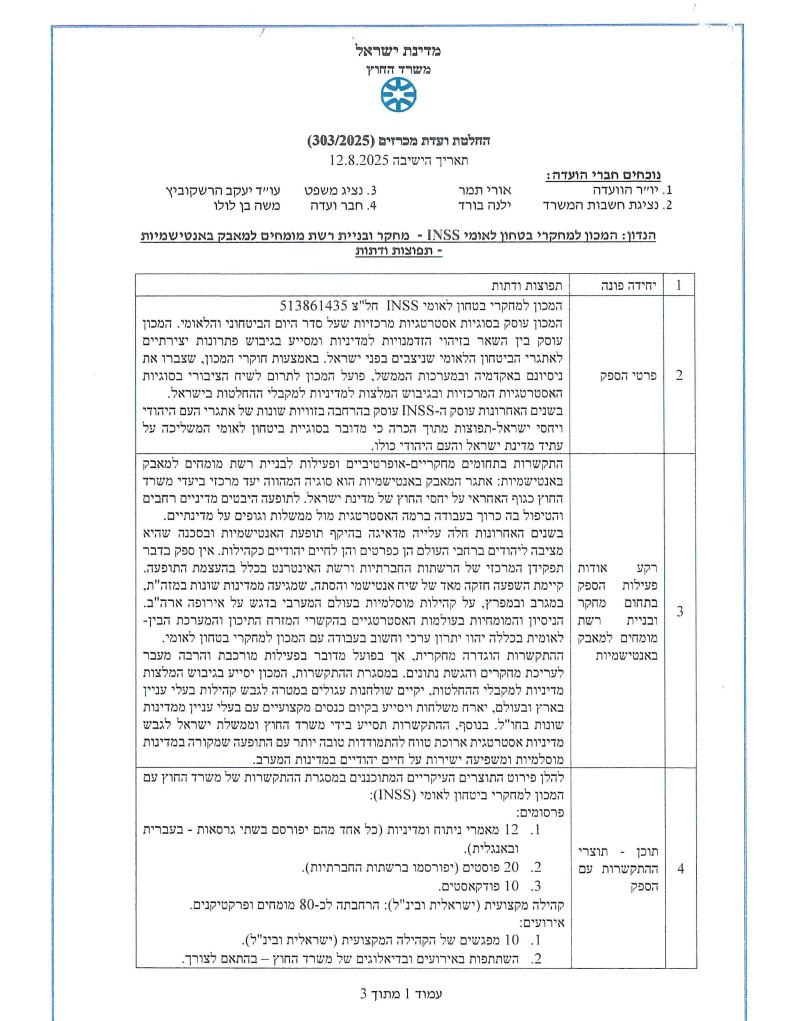
The institute describes itself as independent, but an examination of tender-exemption records revealed direct and recurring cooperation between it and the Israeli Ministry of Foreign Affairs. In 2025, the ministry’s tenders committee approved a contract with the institute under a tender exemption for a project on “combating antisemitism,” valued at 600,000 shekels and set to run through the end of 2026.
The tender-exemption decision submitted by the Israeli Ministry of Foreign Affairs in favour of the Institute for National Security Studies
Israeli Ministry of Foreign AffairsThe ministry that approved the contract
Tenders committee decision 303/2025Session of 12.8.2025
Project subjectResearch and building an expert network to combat antisemitism
Institute for National Security Studies (INSS)The contracted party, and its registration number
1Israeli Ministry of Foreign Affairs — The ministry that approved the contract
2Tenders committee decision 303/2025 — Session of 12.8.2025
3Project subject — Research and building an expert network to combat antisemitism
4Institute for National Security Studies (INSS) — The contracted party, and its registration number
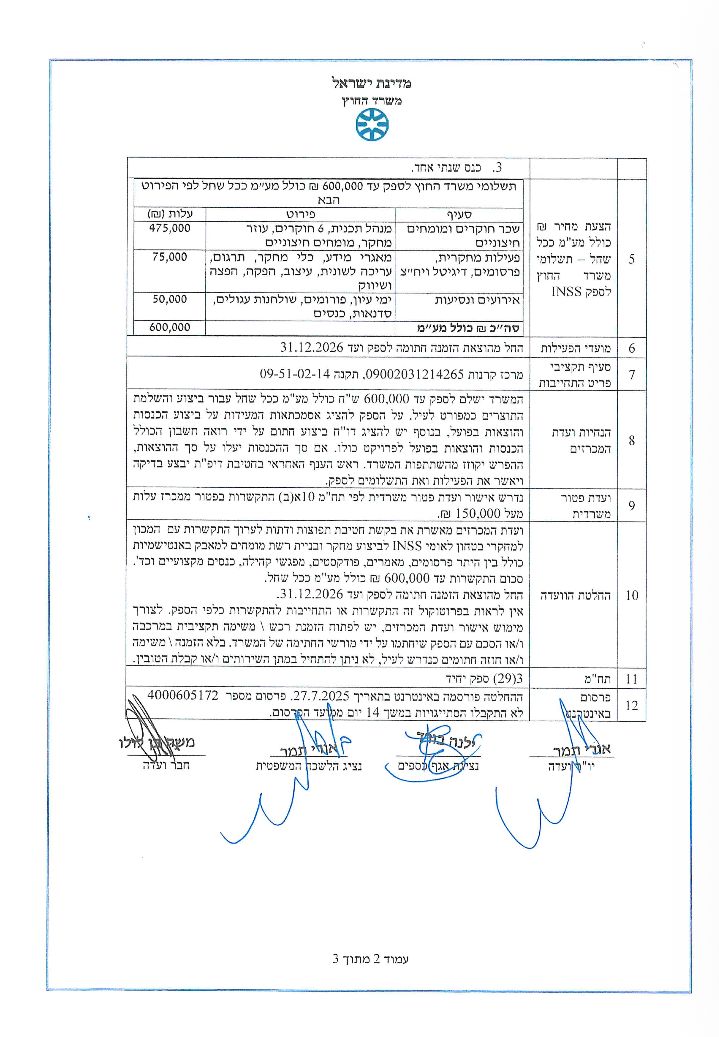
Payment ceiling“Ministry of Foreign Affairs payments to the supplier up to 600,000 shekels including VAT”
Breakdown of the amount475,000 researcher and expert fees · 75,000 research activity · 50,000 events and travel
Total600,000 shekels including value added tax
Implementation periodFrom the signed purchase order until 31.12.2026
1Payment ceiling — “Ministry of Foreign Affairs payments to the supplier up to 600,000 shekels including VAT”
2Breakdown of the amount — 475,000 researcher and expert fees · 75,000 research activity · 50,000 events and travel
3Total — 600,000 shekels including value added tax
4Implementation period — From the signed purchase order until 31.12.2026
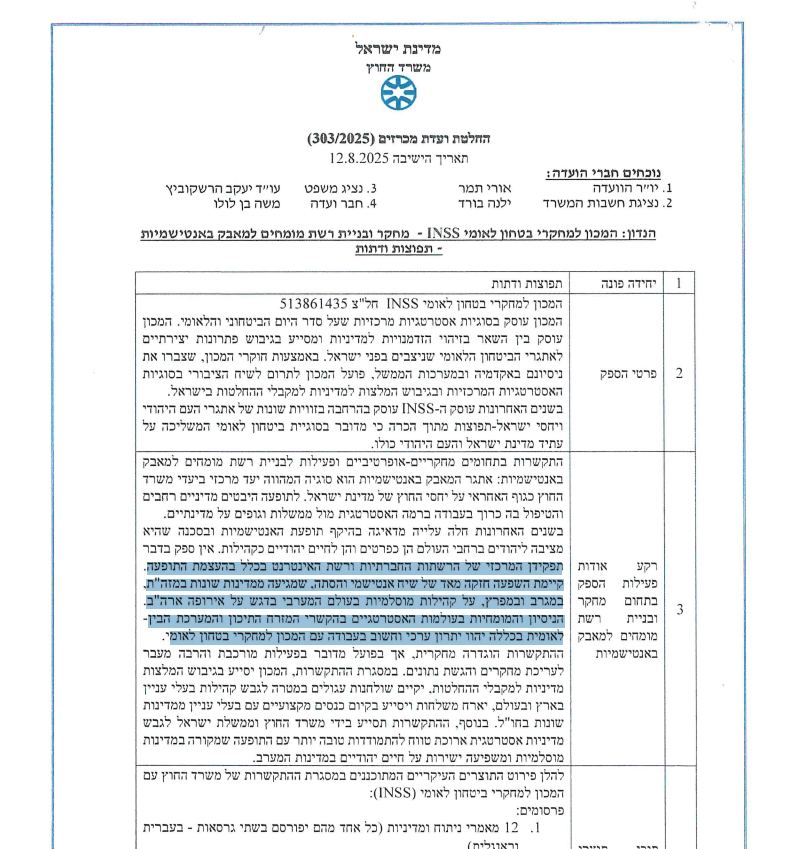
The Arab and Muslim region figures directly in the rationale provided by the Ministry of Foreign Affairs for the project. The document refers to rhetoric it describes as “antisemitic and inflammatory,” originating from countries in the Middle East, the Maghreb, and the Gulf, and says that it influences Muslim communities in the Western world, particularly in Europe and the United States.
Translation of the framed passage
The central role of social media networks, and of the internet in general, in amplifying the phenomenon. There is a very strong influence of antisemitic and inflammatory rhetoric, originating in various countries in the Middle East, the Maghreb and the Gulf, on Muslim communities in the Western world, particularly Europe and the United States.
From the project rationale in the tenders committee decision, under the item “Background on the supplier’s activity.” Translated from Hebrew by Arabic Post.
Keep scrolling
The institute was not commissioned to produce just a single study. The minutes of the tenders committee reveal a package of public-facing outputs, including:
12 research and policy products.
20 social media posts.
10 podcast episodes.
Expanding a professional community comprising around 80 experts and practitioners, holding meetings with Israeli and international experts, and participating in relevant dialogues and events.
The Relationship Predates the 2025 Contract
Further investigation into the relationship between the institute and the Ministry of Foreign Affairs uncovered research cooperation dating back to before 2025, with its stated objective overlapping with the Israeli government’s goals regarding normalization with Arab countries.
The project page on the website of the Israeli Institute for National Security Studies, which the institute produced jointly with the Israeli Ministry of Foreign Affairs.
The institute directly links the project to the Abraham Accords for normalization between Israel and Arab countries, stating that the agreements created an opportunity to deepen Israel’s integration into the region, and that understanding shifts in the attitudes of Arab and Muslim countries and societies toward Jews and Israel is essential to developing the policy tools needed to advance and expand the normalization process between Israel and its neighbors.
Studies Reveal Cooperation Between the Institute and the Israeli Ministry of Foreign Affairs
We examined the outputs produced under the cooperation project between the institute and the Ministry of Foreign Affairs launched in 2023 and found that at least five studies were produced as joint projects between the institute and the ministry.
Among them was a research article published on March 18, 2024, titled “Peace Amid War: The Challenge of Saudi Public Opinion in Advancing Normalization with Israel”. It examined Saudi attitudes toward establishing relations with Israel and the obstacles that could confront any move toward normalization, before shifting from describing public opinion to exploring ways to make normalization more acceptable.
The article concluded that economic ties offering direct benefits to Saudis could increase their willingness to accept relations with Israel, and that Israel’s contribution to “Saudi Vision 2030,” particularly in technology and tourism, could make it easier for the Saudi leadership and religious establishment to persuade the public that peace with Israel would benefit Muslims, in the article’s words.
The Saudi study was not an isolated case. In February 2024, the same institute also published a study titled “Israel and the Jews in Egyptian School Textbooks”, which analyzed how Israel, Jews, peace, and normalization appear in the Egyptian curriculum, and what this material could mean for the future of the relationship between the two countries and the two societies.
At the end of this study as well, INSS states that it was published as part of the joint research project with the Israeli Ministry of Foreign Affairs.
The same acknowledgment at the end of the study on Egyptian school textbooks.
At least five studies that the institute acknowledged were produced within the joint research project with the Israeli Ministry of Foreign Affairs, between February and November 2024. Click any study to open it on the institute’s website.
Jerusalem Institute: A Joint Project with the Ministry of Intelligence
The Jerusalem Institute for Strategy and Security (JISS) was also among the entities identified through “Arabic Post’s” review of government tender-exemption records. The institute explicitly describes itself as an “independent research institute” specializing in policy-oriented studies on foreign affairs and security.
A review of the exemption records shows that the Israeli Ministry of Intelligence contracted with the institute to carry out a joint research project on U.S.-Israeli relations. The initial document set the project’s total value at 200,000 shekels, with the ministry’s contribution capped at 100,000 shekels and the contract set to run for six months.
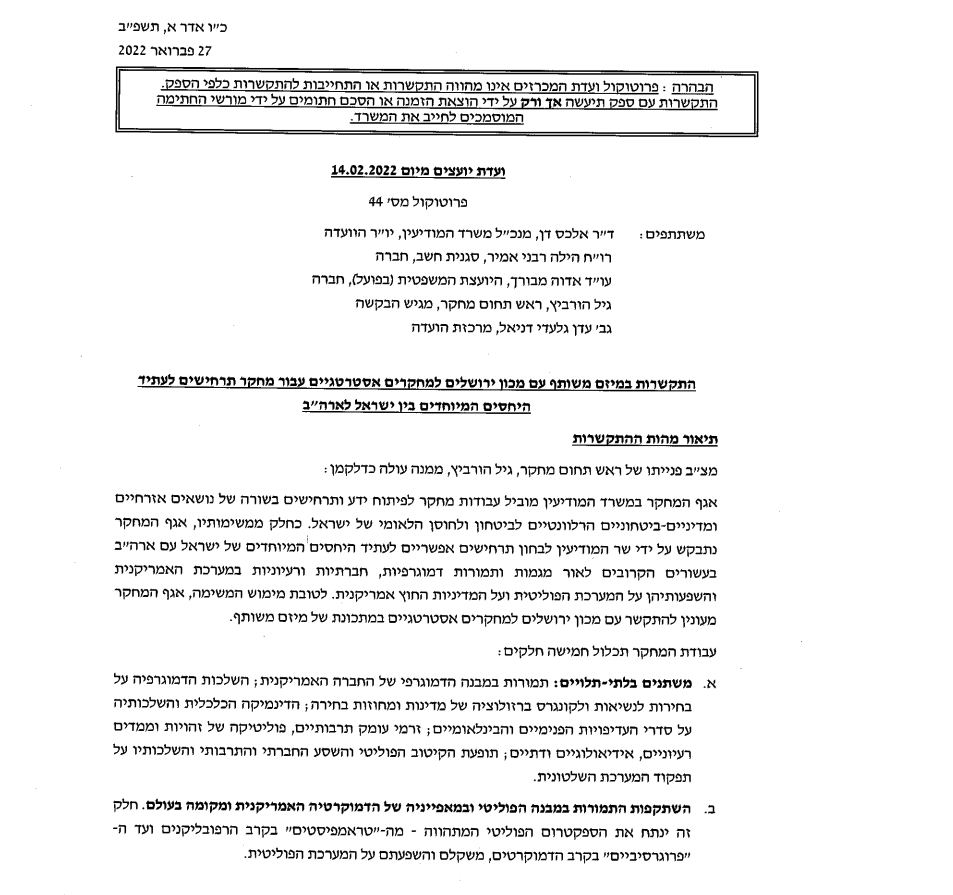
What is particularly notable about the contract is what it reveals about discussions concerning the nature of the cooperation between the Ministry of Intelligence and the research institute. Officials stated that the professional representative of the Israeli Ministry of Intelligence’s research division would determine the research content and the criteria to be examined, and that the final product would require approval from the relevant ministry body. The document further states that the ministry would consider itself the owner of the product and would determine the terms of its publication.
Within this specific project, therefore, the institute was not acting as a center offering an independent assessment that the government subsequently cited after publication, but rather as a contracted entity producing commissioned research whose criteria were determined by the ministry, which would then approve the final product and control the terms of its publication.
The advisory committee protocol at the Israeli Ministry of Intelligence on contracting with the Jerusalem Institute for Strategic Studies
The committee and the protocolAdvisory committee, Israeli Ministry of Intelligence — session of 14 February 2022, protocol No. 44
Who chaired the sessionThe director-general of the Israeli Ministry of Intelligence, as committee chair
Subject of the contractA joint project with the Jerusalem Institute on scenarios for the future of the special Israel–US relationship
Who requested the researchThe ministry’s research division “was asked by the minister of intelligence” to examine the possible scenarios
1The committee and the protocol — Advisory committee, Israeli Ministry of Intelligence — session of 14 February 2022, protocol No. 44
2Who chaired the session — The director-general of the Israeli Ministry of Intelligence, as committee chair
3Subject of the contract — A joint project with the Jerusalem Institute on scenarios for the future of the special Israel–US relationship
4Who requested the research — The ministry’s research division “was asked by the minister of intelligence” to examine the possible scenarios
Who sets the content of the researchThe representative of the ministry’s research division is the one who defines the contents of the research and the criteria by which it is examined
Who approves the productThe final product is approved by the professional body in the ministry
Who owns the productThe ministry is considered the owner of the product
Who sets the terms of publicationThe ministry is the one that sets the terms for publishing the product
1Who sets the content of the research — The representative of the ministry’s research division is the one who defines the contents of the research and the criteria by which it is examined
2Who approves the product — The final product is approved by the professional body in the ministry
3Who owns the product — The ministry is considered the owner of the product
4Who sets the terms of publication — The ministry is the one that sets the terms for publishing the product
What the Institute Publishes Under Its Independent Name
Outside the scope of this contract, “Arabic Post’s” review of some of the institute’s publications found that they align notably with official Israeli policies on several issues, foremost among them the future of the Gaza Strip following the October 2023 war.
22February 2024
Institute paper
On February 22, 2024, institute researcher Gabi Siboni published a paper titled “Israel Must Go Ahead with an Operation in Rafah”, in which he argued that occupying the Rafah area and taking control of the Philadelphi Corridor were “essential to destroying the remaining Hamas battalions,” undermining its governing capacity, reaching the hostages, and cutting off arms-smuggling routes across the Egyptian border.
In April 2025, institute researchers called for creating conditions that would enable what they described as the “voluntary migration” of Gaza’s population. The paper did not merely propose the idea in theoretical terms; it suggested accelerating the departure of Gaza residents, working with receiving countries, and offering those countries economic incentives.
About a month later
12May 2025
Official position
On May 12, 2025, Netanyahu spoke before the Knesset Foreign Affairs and Defense Committee about the “voluntary migration of Gazans” as something that opened up new possibilities. He also spoke of moving the population south of the Morag Corridor to separate them from Hamas and strip it of the means of governance.
It should be noted that these studies do not fall within the contract signed between the institute and the Ministry of Intelligence.
Begin-Sadat Center: Acknowledgment of Contracts with Ministries
In the previous cases, it was Israeli ministries that disclosed the nature of their relationships with research and studies centers. In the case of the Begin-Sadat Center for Strategic Studies, known as BESA, however, the opposite occurred.
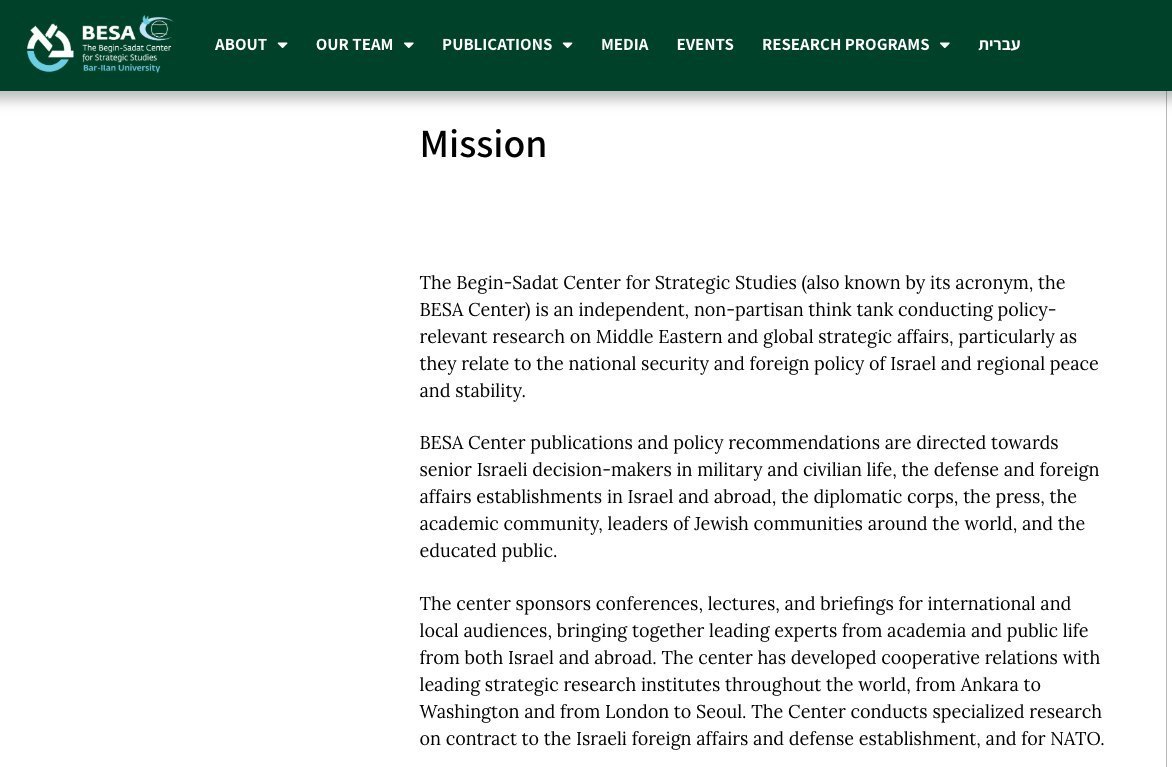
The center did not appear in our review of tender-exemption records, but it states on its own website that it conducts research under contract for Israeli foreign affairs and defense agencies. Despite this acknowledgment, the center describes itself on its website as “independent and non-partisan”.
The Begin-Sadat Center was founded in 1993 by Thomas Hecht and is affiliated with the Department of Political Science at Bar-Ilan University. Its name combines those of Menachem Begin and Anwar Sadat, in reference to the Egyptian-Israeli peace treaty.
The center describes itself as conducting policy-oriented research on Middle Eastern issues and global strategic affairs, particularly those concerning Israel’s national security and foreign policy, as well as regional peace and stability.
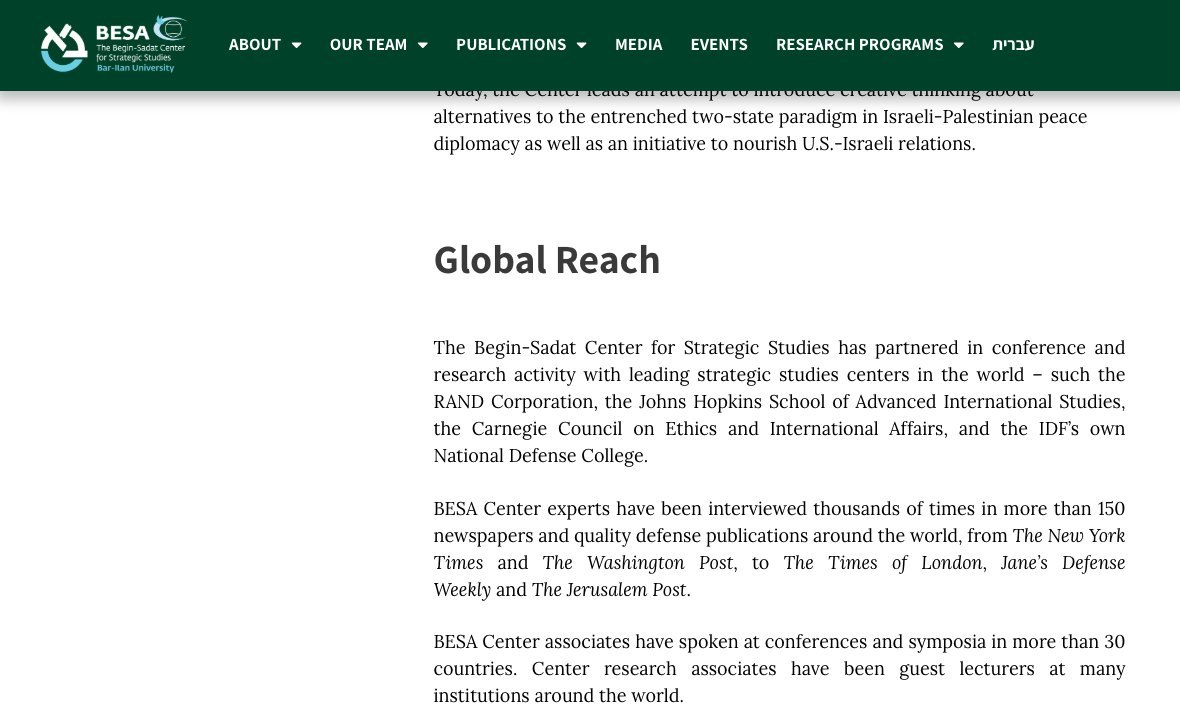
The “Mission” and “Global Reach” pages on the Begin-Sadat Center website
The “Mission” pageThe page where the center defines itself on its website
How it describes itself“An independent, non-partisan research center”
And on the same page“The center conducts specialized research under contract for Israeli foreign affairs and defense agencies, and for NATO”
1The “Mission” page — The page where the center defines itself on its website
2How it describes itself — “An independent, non-partisan research center”
3And on the same page — “The center conducts specialized research under contract for Israeli foreign affairs and defense agencies, and for NATO”
The “Global Reach” pageOn the same website
A partnership with the militaryAmong its partners: “the Israeli military’s National Defense College”
1The “Global Reach” page — On the same website
2A partnership with the military — Among its partners: “the Israeli military’s National Defense College”
The center’s disclosure provides no further details: it does not identify the government bodies or units with which it has contracts, disclose the value or duration of those contracts, or indicate which of its publicly available publications resulted from any specific contract.
Nor is this limited to its director. A review of the backgrounds of the center’s staff shows that several of its most prominent researchers moved into research after holding positions in the Ministry of Strategic Affairs, Ministry of Foreign Affairs, Ministry of Defense, military intelligence, the General Staff, and the military’s senior command.
13
of the 67 names on the centre’s team page are preceded by a military rank. Four of them served in Israeli military intelligence.
At the height of the war on Gaza, BESA researcher Shay Shabtai published a paper in June 2024 on “Five Alternatives for the Future of Gaza”. He placed the destruction of Hamas’s military capabilities and the end of its rule at the forefront of Israeli interests, and argued that the most balanced option was a “military-civilian” model under which Israel would continue striking Hamas until local Palestinian actors could replace it with regional and international support.
Notably, the paper itself states that Netanyahu had been promoting this alternative and that elements of it were reflected in decisions by the Israeli cabinet. Subsequently, the government’s publicly stated conditions for ending the war came to include disarming Hamas, demilitarizing Gaza, retaining Israeli security responsibility, and establishing a civilian administration affiliated with neither Hamas nor the Palestinian Authority.
Misgav Institute: The Ministry of Intelligence Sought to Determine the Research Content
Formal contract requests published by Israeli ministries, in which they announced their intention to contract with research and studies centers, reveal the type of relationship these ministries sought to establish with those centers: what they wanted researched, whom they wanted to conduct the research, and the degree of control they sought to retain over the final product.
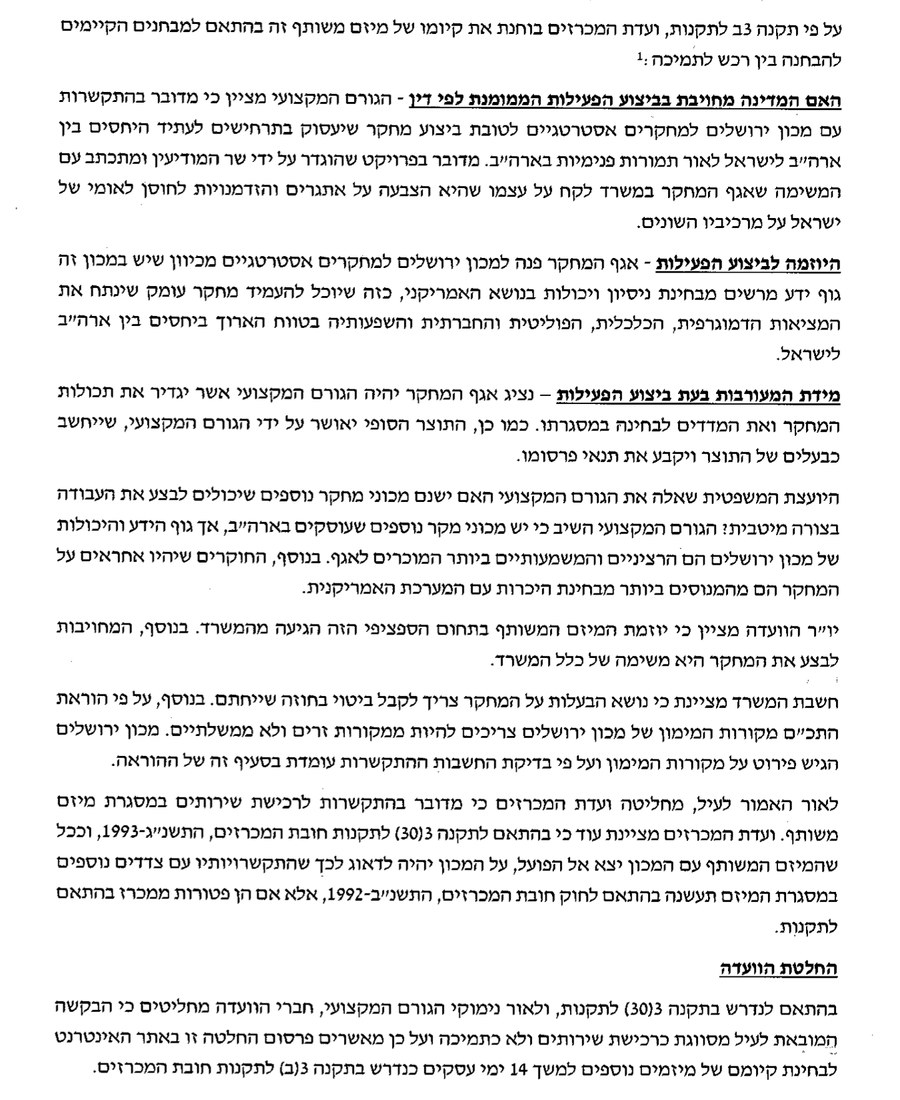
One notable example is the Misgav Institute for National Security and Zionist Strategy, whose name appeared during a review of Israeli government tender-exemption records. The institute describes itself as an independent, non-partisan research center, but contracting requests submitted by the Ministry of Intelligence reveal a research relationship that was intended to give the ministry a direct role in determining the content of a project to be carried out by the institute and reviewing its outputs before publication.
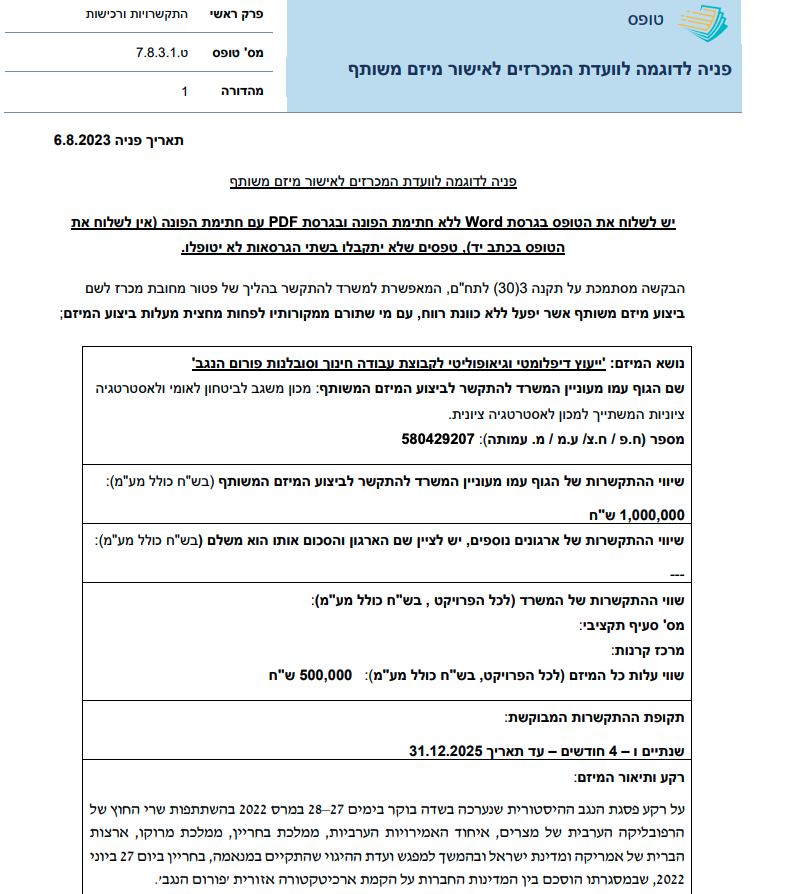
On September 11, 2023, the ministry published a notice titled “Contracting with the Misgav Institute,” classified as an “intent to contract,” rather than a final contract confirmed as having been executed. The project’s estimated cost was up to one million shekels.
The form requesting tenders committee approval for a jointly funded contract with the Misgav Institute
Date of the request6.8.2023 as entered on the form
Project subjectDiplomatic and geopolitical consultancy for the Negev Forum’s “Education and Coexistence” group
The contracted partyThe Misgav Institute for National Security and Zionist Strategy
Contract value1,000,000 shekels
1Date of the request — 6.8.2023 as entered on the form
2Project subject — Diplomatic and geopolitical consultancy for the Negev Forum’s “Education and Coexistence” group
3The contracted party — The Misgav Institute for National Security and Zionist Strategy
4Contract value — 1,000,000 shekels
The project focuses on Israel’s relations with Arab countries within the framework of the “Negev Forum,” which was established in 2022 with the participation of the foreign ministers of Israel, the United States, Egypt, the UAE, Bahrain, and Morocco. Six working groups emerged from the forum, and in September 2022, it was decided that the Ministry of Intelligence would lead the Israeli side of the Education and Coexistence Working Group.
What is notable in the document is the way the research was intended to be produced. The contracting document stipulated that the ministry’s role would not be limited to funding. Rather, the Policy Division at the Ministry of Intelligence, in coordination with project officials at Misgav, would formulate the objectives of the strategic plan and determine its main themes and timetable.
The interim outputs and final product were also to be reviewed by the division before publication, with the ministry retaining exclusive rights to the complete product. It was not to be made public without approval at the ministerial level. Any portions authorized for publication were to be jointly credited to the Ministry of Intelligence and the Misgav Institute.
This document does not mean that the ministry controlled all of the institute’s research, but it does reveal the nature of the relationship the ministry sought to establish with a center that presents itself as independent.
The document also reveals the backgrounds of the individuals selected to participate, foremost among them Meir Ben-Shabbat, president of the Misgav Institute, who served as Israel’s National Security Adviser and head of the National Security Council from 2017 to 2021, in addition to working for nearly three decades in the Israel Security Agency, Shin Bet.
The document describes him as having particular expertise in the Abraham Accords, which laid the groundwork for the establishment of the “Negev Forum,” while the institute presents him as one of the architects of those accords.
The document also names Asher Fredman, who is affiliated with the Abraham Accords Peace Institute and previously held positions in Israel’s Ministry of Strategic Affairs, including chief of staff to the minister, and served as a policy adviser to the Minister of Public Security.
From the document itself: the highlighted paragraph listing the names put forward to take part in the project.
“Arabic Post” tracked the materials published by Misgav during the period in which the project was supposed to be underway, searching for studies or papers that explicitly stated they had been produced as part of cooperation with the Ministry of Intelligence, as was the case with INSS and the Ministry of Foreign Affairs, but found no such results.
That, however, does not necessarily prove that the project was not implemented or that it was concealed, particularly since the government document itself gave the ministry the right to prevent its publication or to publish only portions of it.
At the same time, a review of the institute’s publications revealed a clear overlap between several of its publications and the topics the ministry had requested be studied. It also led to one of the names mentioned in the project document: Asher Fredman.
In May 2024, the institute published a paper by Fredman titled “Israel’s Regional Challenges After October 7,” addressing the war’s impact on Arab public opinion and the decline of what he described as “warm peace” and societal ties in Abraham Accords countries.
These topics resemble those the Ministry of Intelligence had requested be studied in its document: shifts in Israel’s relations with the forum’s member states, the cultural, political, identity-based, and religious currents within them, and the factors that could either obstruct cooperation or help expand it.
Research on “Radical Islam in the West” and Media Promotion of Its Findings
Tracing the Israeli Ministry of Foreign Affairs’ relationships with research entities led to the Israel Defense and Security Forum, which is associated with an Israeli organization that includes research, policy, and media arms, known as “HaBithonistim.”
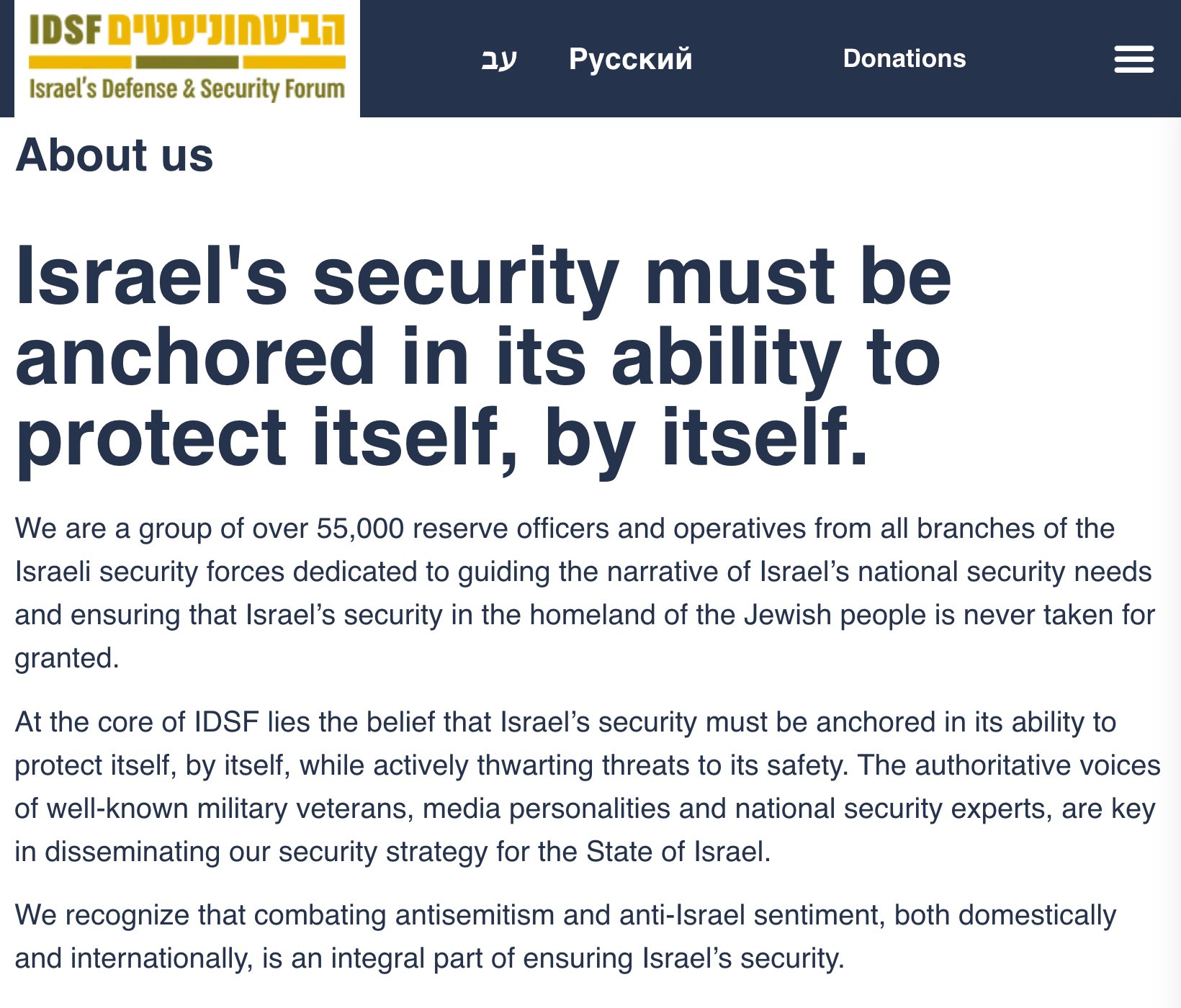
The movement describes itself as a Zionist security movement comprising more than 55,000 reserve officers and personnel from various branches of Israel’s security services, and says it seeks to influence decision-makers and the media inside and outside Israel.
Its website says that its research division publishes studies for the public, media, and policymakers, and that the movement also works through traditional media and social networks in “every relevant language.”
More than 55,000 reserve officersFrom all branches of the Israeli security forces
Guiding the narrativeThe movement says it is dedicated to guiding the narrative of Israel’s national security needs
Who carries the messageThe voices of well-known military veterans, media personalities and national security experts are key to disseminating its security strategy
Combating antisemitismThe movement regards it as an integral part of ensuring Israel’s security, domestically and internationally
1More than 55,000 reserve officers — From all branches of the Israeli security forces
2Guiding the narrative — The movement says it is dedicated to guiding the narrative of Israel’s national security needs
3Who carries the message — The voices of well-known military veterans, media personalities and national security experts are key to disseminating its security strategy
4Combating antisemitism — The movement regards it as an integral part of ensuring Israel’s security, domestically and internationally
The “About us” page on the Israel Defense and Security Forum website, accessed 26 August 2026.
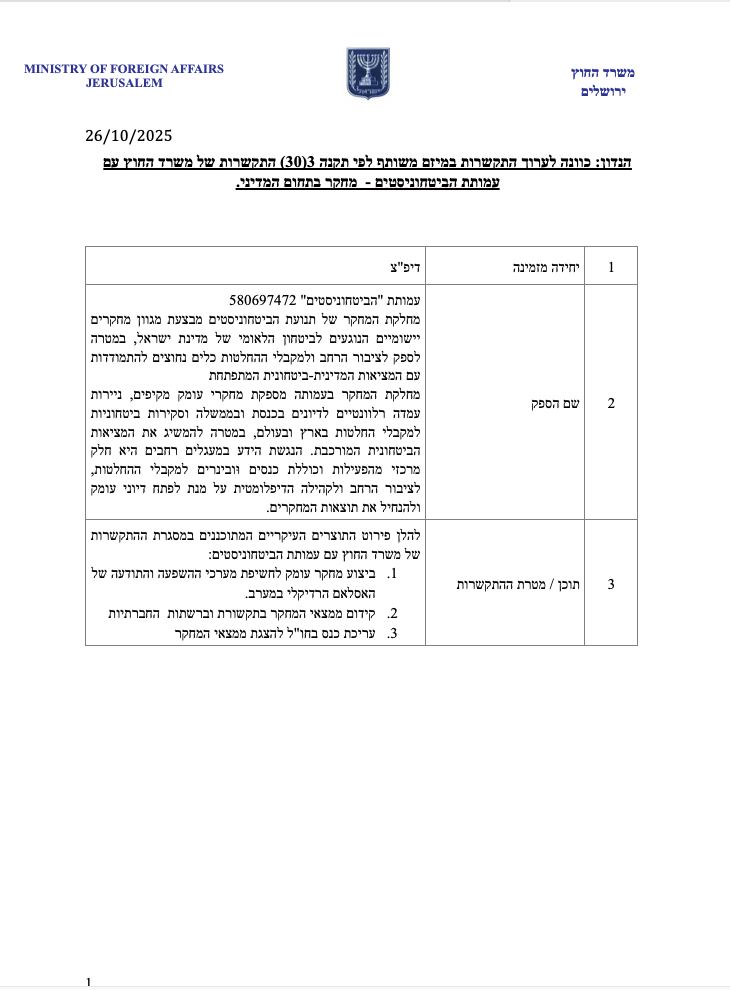
In October 2025, the movement appeared in a document issued by the Israeli Ministry of Foreign Affairs revealing the ministry’s intention to carry out a joint research project with it, valued at 370,000 shekels. The ministry specified three main outputs for the proposed project.
The first was to conduct “in-depth research to expose the influence and awareness systems of radical Islam in the West”; the second was to promote the research findings in the media and on social networks; and the third was to organize a conference outside Israel to present the findings. These terms, including the description “radical Islam,” are the language used in the government document itself.
The Israeli Ministry of Foreign Affairs document on its intent to contract a joint project with the “HaBithonistim” association
Date of the document26/10/2025
Subject of the documentIntent to contract a joint project between the Israeli Ministry of Foreign Affairs and the “HaBithonistim” association — research in the political field
The contracted partyThe “HaBithonistim” association, registration number 580697472
Project outputsThree outputs specified by the ministry: in-depth research, promotion of its findings in the media and on social networks, and a conference outside Israel to present them
1Date of the document — 26/10/2025
2Subject of the document — Intent to contract a joint project between the Israeli Ministry of Foreign Affairs and the “HaBithonistim” association — research in the political field
3The contracted party — The “HaBithonistim” association, registration number 580697472
4Project outputs — Three outputs specified by the ministry: in-depth research, promotion of its findings in the media and on social networks, and a conference outside Israel to present them
In the justifications submitted by the Ministry of Foreign Affairs for selecting the Israel Defense and Security Forum, the ministry pointed to previous products by the forum that it viewed as examples demonstrating its ability to conduct the required study.
Among them was an earlier study titled “The Day After Abu Mazen: Where Palestinians on Social Media Stand”, which the ministry describes as a social-network analysis comparing the popularity of Hamas and Fatah on TikTok, Twitter, and Facebook, based on hundreds of groups, profiles, and hashtags. It noted that the team conducting the analysis included an Arabic speaker, a data scientist, and a security analyst specializing in Palestinian affairs.
This is almost exactly the same team structure that the Ministry of Foreign Affairs sought to use for the new project on what it describes as “radical Islam in the West.”
As in the case of the Jerusalem Institute, a review of materials published by the movement before the Foreign Ministry’s announcement shows that its focus on political Islam and its influence in the West did not begin with the government project.
In May 2025, several months before the contracting announcement, the movement’s website published an article titled “Why Doesn’t the EU Take a Strong Stance Against Hamas?”, which argues that the Muslim Brotherhood used umbrella organizations to build influence within European politics and academia, presenting this as one explanation for what the author sees as the prevalence of anti-Israel positions in certain European sectors, according to the article.
In June 2025, the website published another article titled “Israel Is Effectively the Leader of the West”, portraying Israel as the West’s front line in confronting what it calls “radical Islam,” whether in its Iranian form or in the form of the Muslim Brotherhood.
The contents of Israeli ministries’ requests to contract with research centers that receive attention in Western and Arab media show that the issue goes beyond who funds some of the research produced by these centers and subsequently cited or republished by media outlets and research institutions outside Israel.
Rather, it raises broader questions: How are some of the studies picked up by Western—and at times Arab—media produced when they concern regional issues in which Israel is directly involved or that are connected to its interests and policies toward the region? And who participates in determining the questions asked, the scenarios discussed, and the recommendations that ultimately reach decision-making and media circles?